
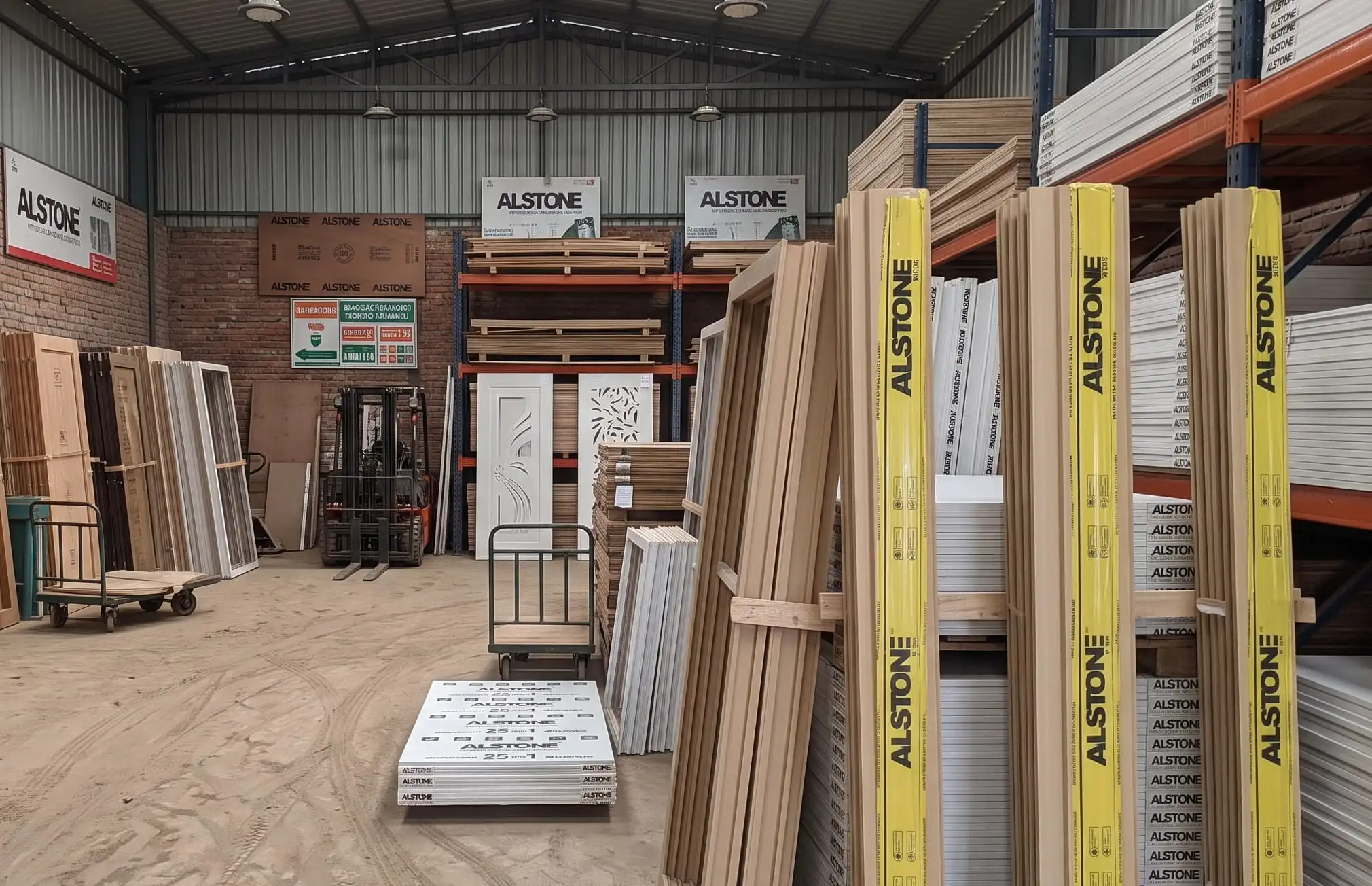
| Technical Parameter | Alstone Engineered WPC Profiles | Conventional Timber / Batten Flush Doors & Plywood |
|---|---|---|
| Material Density & Homogeneity | The solid extruded matrix extends continuously from edge to edge, with a density ranging from 0.55 to 0.65+ g/cm³ in the case of the door sheets and from 0.85 to 1.00 g/cm³ in the case of the solid doorframes; the tolerance is uniform during CNC machining. | The core density is unpredictable (0.40–0.50 g/cm³ on average), and often has inner hollows, gaps in the softwood filler, and concealed joints. |
| Moisture Absorption & Weathering | Under IS 4020, there is 0.00% water absorption, and it will not swell, warp, or split at the edges even if it is in areas that are wet every day or in coastal humidity. | It takes in moisture from the environment amounting to 12% to 25%. This can lead to swelling, binding of the jam, peeling of the face veneers, and the cores becoming soggy and rotted. |
| Termite & Insect Resistance | It is 100% immune in terms of composition and has no free starches, lignins, or cellulose, all of which are nutrients that attract wood-boring pests. | Very susceptible to attack by subterranean termites and the larvae of wood-boring beetles. It requires frequent and dangerous spraying to protect against termites. |
| Fire Performance | It is classified as Class-1 self-extinguishing (in accordance with the UL-94 standard), stopping the spread of flame as soon as the source is removed and not producing any burning drips with very low smoke emission. | It is highly flammable and will speed up the occurrence of room flashover, producing a lot of black smoke and toxic carbon monoxide fumes. |
| Screw Holding & Hinge Anchoring | The screws provide a pull-out retention of 2,300 N and can hold heavy-duty steel butt hinges with continuous pivoting and overhead closers without them loosening. | Below 1,200 N, the screws become loose as a result of ordinary commercial slamming, leading to sagged shutters and misaligned latches. |
| Toxicity & Indoor Safety | It complies with the RoHS regulations, is entirely free from lead, and has zero formaldehyde or VOC outgassing. It also directly contributes to the IGBC and GRIHA rating credits. | The material is bonded using urea-formaldehyde adhesive resins and continuously emits VOC vapours and formaldehyde during the first few years after occupancy. |
| Upkeep & Long-Term Costs | Clean it entirely, without any sanding, sealing, polishing or painting during the 25-year structural service life. | It requires the work of repainting or re-varnishing every few years, has its plane adjustments made during the rainy season, and is generally entirely replaced after 5 to 8 years. |
| Department Empanelment Status | The formal appointment and scheduling have been carried out in accordance with the specifications of CPWD, MES, UP PWD, Indian Railways and the Central PSUs. | Individual batch inspections are required, along with repeated supplier clearances and frequent rounds of destructive testing. |

Scope: We provided over 1,200 solid WPC door shutters and damp-proof bathroom assemblies for multi-storey residential towers.
On the ground: No water-swelling problems were reported in the wet utility areas; the material showed high resistance to rough treatment and finally put an end to the recurring termite damage which had affected the older wooden blocks.
Scope: The shutters, ventilation louvers and sanitary cubicle partitions supplied are made of heavy-duty 30mm Class-1 fire-retardant WPC and are designed to handle continuous passenger foot traffic.
On the ground: It is unaffected by the daily high-pressure hose-downs, the aggressive chemical disinfectants, and the heavy wear caused by large crowds, remaining plumb and intact without delaminating.
Scope: The work involved fitting heavy-duty doors and solid chaukhat fittings in the student accommodation at IIT Kanpur and in several Government Engineering Colleges located in Jhansi, Kanpur, Noida (Gautam Buddha Nagar) and Ghaziabad.
On the ground: The hardware remained firmly locked in place year after year without showing hinge sag or having the closer bracket pull out.
Scope: The scope includes the provision of furnished approved WPC chaukhats and flush shutters for the railway residential colonies in the Moradabad, Gorakhpur and Bareilly divisions, as well as for the Military Engineer Services cantonment facilities in Meerut.
On the ground: The performance met the strict requirements set out in the BOQ and it passed strict defense quality inspections, demonstrating its resilience in the hot summer conditions and humid monsoons of Northern India.
“The vendor’s track record plays a decisive role in qualifying them for public works contracts; in places such as the high-traffic student hostels at IIT Kanpur and in the sensitive MES defense areas, Alstone components have always achieved near-zero failure rates and have easily passed departmental audits.”
Districts Covered: Noida, Greater Noida, Ghaziabad, Hapur, Meerut.
Fast-track factory dispatches are carried out for commercial developments, smart city administrative complexes, police lines and CPWD regional works.
Districts Covered: Lucknow, Kanpur, Rae Bareli.
Support is provided directly for the addition of offices to the state secretariat, for the university campuses (such as IIT Kanpur and AKTU), for upgrading the medical college, and for the government staff quarters.
Districts Covered: Moradabad, Bareilly.
Railway housing schemes, bus terminals, district healthcare facilities and civic centres are being provided.
District Covered: Jhansi.
The provision of composite doors which are both thermally stable and impact resistant for use in technical campuses, defense accommodations and healthcare facilities under extreme weather conditions.
Districts Covered: Agra, Aligarh, Mathura.
Civic tourism facilities, educational buildings, and various public utilities that must be able to resist ground dampness and dry rot.
Districts Covered: Varanasi, Gorakhpur.
Furnishing the railway division head offices, the smart city hubs, and the medical centres located along the Purvanchal Expressway network.
India’s weather doesn’t hold back at all. One moment you are dealing with coastal monsoons; the next you are stuck in humid river areas or suffering under hot summer days. And don’t forget the Himalayas—those winters are really tough. Traditional building materials? They just can’t handle it. Wood bends and expands; plywood becomes wet and weak. The weather basically destroys them. Alstone Industries saw that for what it was—a chance that no one else was really trying to take.
In 2009, when most people were being careful, Alstone fully committed to Wood Polymer Composite (WPC) technology. They introduced products before the rest of the market even knew what WPC was. Their secret was to start with new polymers. Mix in wood fibers. Add mineral stabilizers, and you get boards that look and feel like real wood, but that is where the similarity ends. Rot? Not a problem. Water damage? Not possible. Insects, mold, and any creature that usually damages wood? They don’t even bother. Alstone’s boards don’t bend. They definitely don’t fail—not in India’s weather.
Now today Alstone is at the top of India’s WPC industry. Their factories make quality, steady boards and their supply chain reaches all over the country. You will see their brand in government projects, big corporate places, modern private homes—it is hard to miss. It is not just about delivering stacks of WPC boards. Customers get choices: any size, any thickness, whatever their project needs. They also get help from Alstone’s team of engineers and technicians—people who really know their stuff and make sure everything works properly on site. The whole system is designed for India—built to take whatever the country can throw at it.
That is why builders keep choosing Alstone. The weather changes from one city to another. The performance stays the same. Their reliability, support, and focus on quality have made them trusted by everyone, whether you are building a highway rest area or a high-end apartment. Alstone is not just selling boards—they are helping India build for the future.
Yes. Alstone WPC (Wood Polymer Composite) doors, doorframes (chaukhats), and boards are empanelled and approved across major public sector schedules including CPWD, Military Engineer Services (MES), Uttar Pradesh Public Works Department (UP PWD), and Uttar Pradesh Rajya Nirman Sahkari Sangh (UPRNSS), with a proven track record across executed infrastructure projects.
For government tenders, WPC door shutters require a minimum calibrated density of 0.55 to 0.65 g/cm³ (such as Alstone Apex 600 or Hercules 800), while solid WPC doorframes (chaukhats) must meet high-density benchmarks of 0.85 to 1.00 g/cm³ (Alstone Neo 850 & Ultra 1000) with face screw withdrawal resistance exceeding 2,300 N.
Alstone WPC is classified as Class-1 Flame Retardant and Self-Extinguishing under UL-94 and relevant Indian Standard testing. It exhibits zero flame propagation, low smoke density, and halts combustion immediately once the primary heat source is removed.
Yes. We provide complete institutional tender support including NABL-accredited test reports, BIS/IS compliance certificates, material safety datasheets (MSDS), physical sample inspection kits, and official factory visit invitations for technical clearance boards.
Direct bulk site dispatches are operational across all key economic belts in Uttar Pradesh: Gautam Buddha Nagar (Noida/Greater Noida), Ghaziabad, Hapur, Meerut, Moradabad, Bareilly, Lucknow, Kanpur, Rae Bareli, Jhansi, Agra, Aligarh, Mathura, Varanasi, and Gorakhpur.